
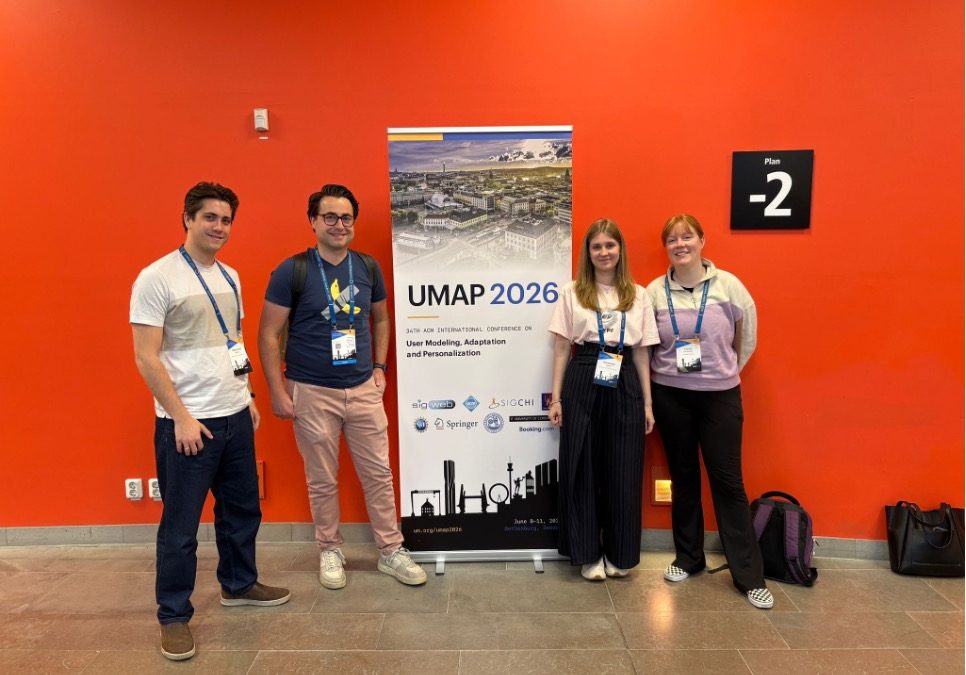
MediaFutures researchers at ACM UMAP 2026 in Gothenburg. From left: Tobias Wessel, Alain D. Starke, Svenja L. Forstner, and Yelyzaveta Lysova.
MediaFutures researchers presented several new studies at ACM UMAP 2026, the 34th ACM Conference on User Modeling, Adaptation and Personalization, held in Gothenburg, Sweden.
The MediaFutures team at the conference included Tobias Wessel, Svenja L. Forstner, Alain D. Starke, and Yelyzaveta Lysova. Together, the researchers presented work addressing key questions in responsible AI, recommender systems, news personalization, and human interaction with AI-generated content.
Tobias Wessel presented the paper “Increasing Editor Trust in News Personalization Systems with Fact-checked Large Language Models”, co-authored with Christoph Trattner and Alain D. Starke. The paper investigates how fact-checked large language models can support more trustworthy news personalization systems for editorial use.
Svenja L. Forstner presented “Explanations for Recommended Low-Interest News Articles Fail to Persuade Selective News Avoiders” at the INRA Workshop at ACM UMAP 2026. The paper, co-authored with Alain D. Starke and Christoph Trattner, examines whether explanations can encourage readers to engage with important news articles they would otherwise avoid. The findings suggest that explanations alone are not enough, pointing to the need for more user-centered and context-sensitive approaches to news recommendation.
Yelyzaveta Lysova presented “Using AI as a Chef: Users Overlook Nutritional Flaws in LLM-Generated Recipes”, co-authored with Christoph Trattner and Alain D. Starke. The study explores how users assess recipes generated by large language models, showing that people may overlook important nutritional weaknesses in AI-generated food content.
Together, the papers reflect MediaFutures’ broader mission to develop responsible media technology and AI systems that are trustworthy, useful, and aligned with societal needs.