
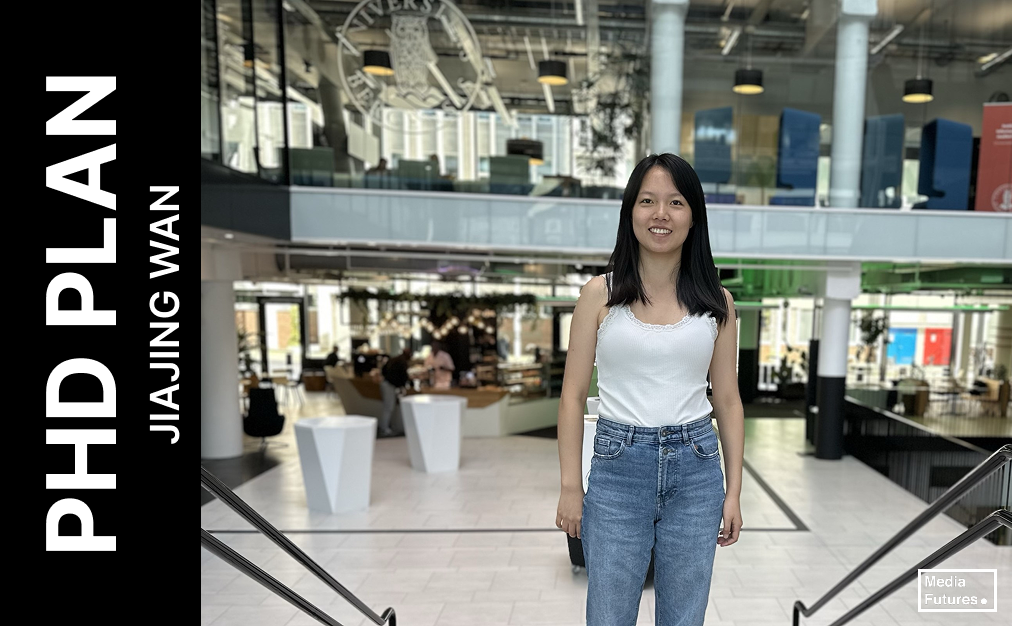
MediaFutures PhD candidate Jiajing Wan will be working on answering this question during her three year PhD position at SFI MediaFutures. She has previously been part of projects investigating the effectiveness of rumour refutation on social media and personalized news headline generation. Now, she wants to find out how to extract user style preferences and used them to generate personalised news contents.
Why does personalisation of news matter?
News personalisation is one way of trying to engage readers to read more news. At MediaFutures, we work together with media partners to explore how tailored news experiences can help increase engagement and make journalism more relevant to different audiences.
The aim of personalized news generation is to add a preferred style to news to encourage the user to read more news. This can be by for example writing the text more satirical, using rather questions than exlamation in headlines or have more subtitles. News media is constantly pondering how to get more people to read their news. This research might help them in reaching and holding their target audience even better.
Wan is currently in her first year and has just submitted her first article at the EACL (European Chapter of the Association for Computational Linguistics) conference. In this paper she discusses retrieval-augmented generation (RAG) as a method. This model takes the info from user profiles and their browsing history, and incorporates them during the generation of personalised headlines. .
In the first phase of her PhD she has explored how to extract user styles such as topic preference, and article style preferences to apply it to the generation task.
Wan is currently focusing on an open-source dataset of English news articles that contain various types of metadata, including information about users and their preferences with news content, and headlines generated by users that reflect their own style preferences. After the personalised generation, Wan evaluates the performance of her models by comparing them to the user-created personalised headlines.
“We want to evaluate the degree of the personalization. Therefore, we use the classifier based on the user history to do the score and check whether the generated news matches the user style or not.”
Wan has built a RAG-model combined with a language model, where she both extract information about the users, ranks the most salient content to guide the personalzation, and the generate personalized headlines. In the upcoming year of her PhD, Wan will further explore various types of personalized content generation in collaboration with the media partners in WP5.
As MediaFutures aims to develop responsible media technology for the benefit of society, Jiajing’s PhD project also emphasizes the ethical dimensions of AI-driven news personalisation. This includes ensuring transparency in how algorithms select and adapt content, protecting user privacy, and preventing biases that could limit diversity of perspectives. By integrating responsible AI principles from the start, the project seeks to balance technological innovation with editorial integrity, supporting MediaFutures’ mission to make digital media more trustworthy, inclusive, and human-centred.