

- This event has passed.
News experience: Understanding why and how audiences interact with news beyond audience metrics
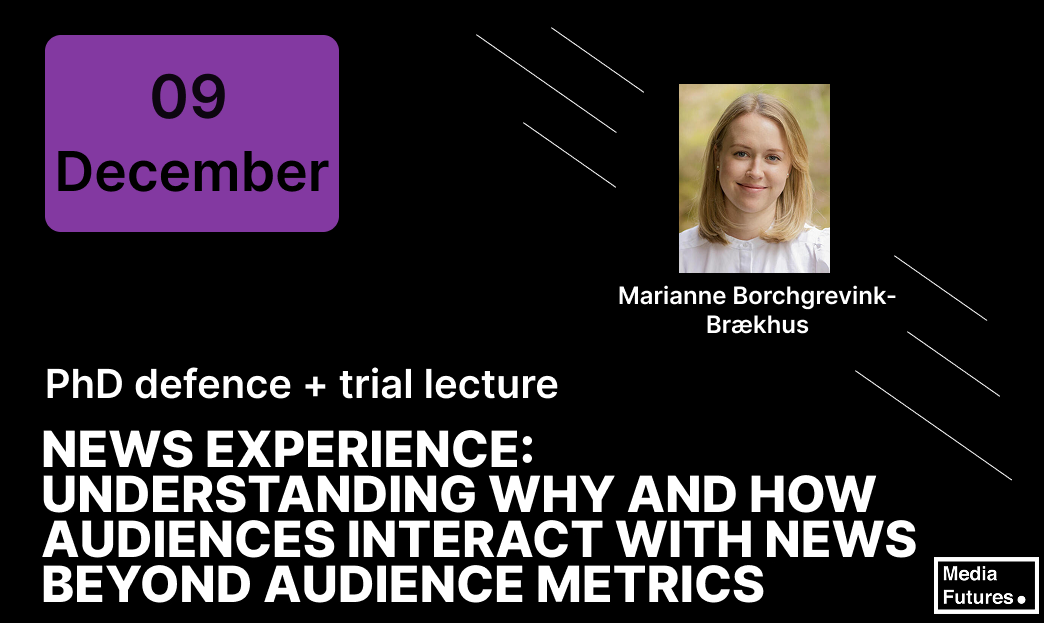
We are pleased to invite you to the trial lecture and public defence of Marianne Borchgrevink-Brækhus, PhD candidate at SFI MediaFutures.
Date: 9 December
Venue: Ulrikes Aula, Ulrike Pihls hus
Time: The trial lecture starts at 09:15 and the defense begins at 10:30.
PhD Thesis:
News experience: Understanding why and how audiences interact with news beyond audience metrics
Thesis Summary:
This thesis explores how we can understand news use as experience. While audiences have become increasingly central to professional journalism and journalism studies, understandings of audience practices and behaviors are predominantly shaped by digital trace data. Yet, despite this growing attention to audiences, news practitioners and scholars continue to talk more about audiences than with them. As a result, our knowledge about people’s interactions with news, and what these practices actually mean, remains limited. Against this backdrop, I approach news use as experience. I ask how we can further a more nuanced understanding of why and how audiences use news, starting from the vantage point of the audience.
To address these questions, I employ a multi-method research design, combining recurring interviews and media diaries, supplemented with video-ethnography and data donations. Drawing on the empirical insights provided by this multi-method approach, I refine the concept of news experience, emphasizing the importance of contextualizing understandings of news use within people’s everyday lives. By studying news use from an audience-centric perspective – bridging traditional qualitative methods with innovative digital ethnographic approaches across different media formats and platforms – I identify different experiences with news that both shape people’s practices and behaviors.
The empirical material is analyzed through four articles. The first article explores why young adults are reluctant to subscribe to digital news. I do this by analyzing experiences of young non-subscribers. The article provides insights into their considerations of why they do not subscribe as well as how they maneuver around paid news content. The second article offers a conceptualization of media experience, demonstrating how this concept is well-attuned to grasp the ingrained position and meaning media hold in people’s lives. Applying conceptual principles from the second article, the third article refines news experience as an analytical lens to understanding why and how people interact with news in everyday life, empirically grounded in six distinct forms of experience shaping people’s practices. Finally, the fourth article critically assesses the metric of “time spent” by analyzing how people navigate when reading news online, and how short digital news practices relate to meaningful experiences with news.
By talking with people instead of about them, this thesis critically assesses longstanding assumptions and misconceptions about audiences and their (digital) behaviors at a time when VI audience metrics have become integral to professional journalism and journalism studies. While I situate my research in relation to the audience turn in journalism research, this thesis contributes to the existing literature by detailing methodological and epistemological implications of studying news use as experience. In doing so, my research recognizes the lived, contextual dimensions of everyday life that ultimately give shape and meaning to people’s news practices: it demonstrates how audiences’ behaviors are formed not merely by perceptions of the news content itself, but also by embodied, material, and technological dimensions; the spatial, temporal, and social contexts in which it unfolds; and by their identities and previous knowledge. As such, the thesis explicates how news use can result from conscious and explicit, as well as unconscious and tacit practices and behaviors. I therefore argue that digital trace data – although relevant for identifying patterns and trends – cannot be applied as proxies for people’s interests or preferences. These insights are not only relevant from a societal perspective and to the field of journalism studies to inform more balanced assessments of news use in digital societies, but also in professional terms as media organizations justify their policies and financial investments on the basis of such metrics.
Opponents:
- Professor Jannie Møller Hartley, The Department of Communication and Arts, Roskilde University
- Professor Marcel Broersma, Centre for Media and Journalism Studies, University of Groningen
Leader of committee:
Professor Dag Elgesem, Department of Information Science and Media Studies, University of Bergen.
Chair of the defense:
Professor Leif Ove Larsen, Department of Information Science and Media Studies, University of Bergen.