

- This event has passed.
Recommender Systems and Nudges for Healthier Food Choice
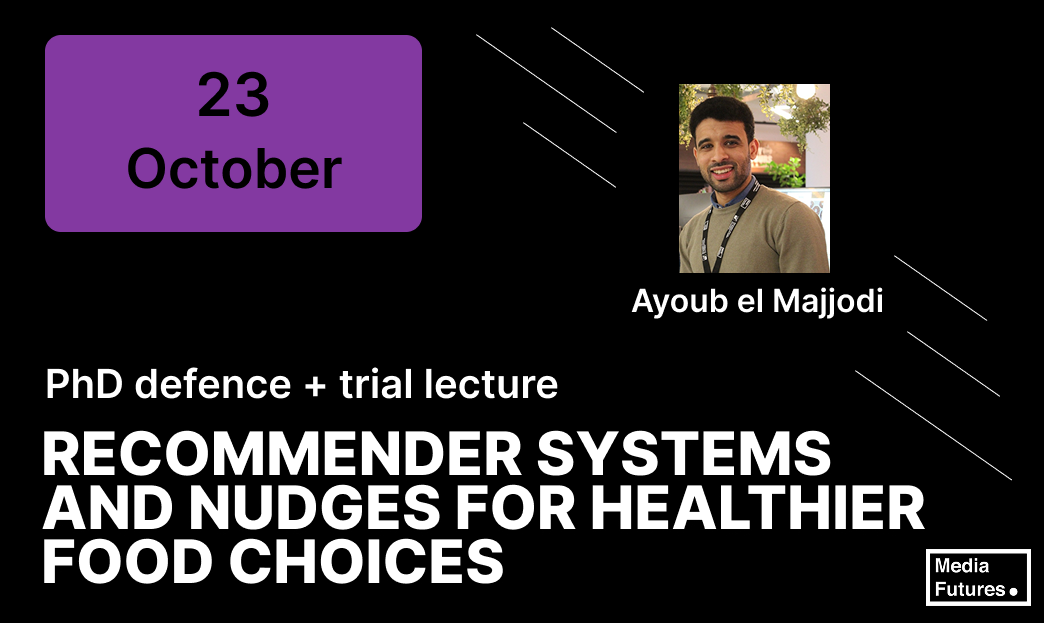
We are pleased to invite you to the trial lecture and public defence of Ayoub el Majjodi, PhD candidate at SFI MediaFutures.
Date: 23 October
Venue: Auditorium 2 Jussbygget, UiB
Time: 9:15
PhD Thesis:
Recommender Systems and Nudges for Healthier Food Choices
Thesis Summary:
Recommender systems are widely used to address the challenge of information overload by presenting users with the most relevant content through personalization techniques. In the food domain, decision-making is particularly complex due to the multifaceted nature of food choices, which are influenced by a range of individual, contextual, and environmental factors. Despite this complexity, recommender systems have shown considerable promise in modeling real world food preferences and supporting users in navigating food related decisions. Their adoption in food applications has been steadily increasing, reflecting the growing importance and difficulty of making informed, personalized, and health-conscious dietary choices. Nonetheless, these systems have often been shown to generate predom- inantly popular food options, which tend to be less healthy. As users interact with such systems, they are repeatedly exposed to unhealthy choices, which in turn reinforces their preferences for these items. This feedback loop causes algorithms to prioritize popular yet nutritionally poor options, ultimately amplifying unhealthy eating behaviors with potential negative implications for public health. At the same time, digital nudging has emerged as a promising strategy for influencing user behavior in subtle and non intrusive ways. How- ever, limited research has investigated how digital nudges and recommender systems can be effectively combined particularly in user-centered settings aimed at supporting informed decision-making and promoting behavioral change. To address this gap, this thesis adopts a Design Science Research methodology to design, implement, and evaluate food recommender systems augmented with digital nudges. The research is documented across several peer-reviewed manuscripts and supported by both offline algorithmic evaluations and online user experiments. These studies examine how various preference elicitation methods, nudging techniques, and user characteristics such as food knowledge and dietary goals interact to shape user experience and behavior. The findings reveal that several nudging techniques warrant further investigation in the con- text of food recommender systems, particularly through user-centric evaluation approaches. Moreover, while digital nudges can support healthier food choices, their effectiveness varies depending on personalization, user familiarity, and system design. Interestingly, non-personalized recommendations with clear nutritional labeling were often more effective in encouraging healthy decisions than personalized options. Additionally, the interplay between preference elicitation methods, user knowledge, and nudging strate- gies significantly influenced user choices, interactions, and overall experience. This thesis contributes to the fields of recommender systems and persuasive technologies by demonstrating how digital nudges and system design features jointly influence health related decision-making. It emphasizes the importance of user-centric evaluation and lays the foundation for future research on adaptive nudging, long-term behavior change, and real- world deployments in food-related digital platforms.
Opponents:
Associate Professor Alan Said, University of Gothenburg, Sweden
Assistant Professor Julia Neidhardt, TU Vienna, Austria
Chair of the Committee:
Associate Professor Erik Knudsen, Department of Information Science and Media Studies, University of Bergen
Defense Chair:
Associate Professor Samia Touileb, Research Leader at the Department of Information Science and Media Studies, University of Bergen