
This year, five talented PhD candidates from SFI MediaFutures achieved a milestone by successfully defending their PhD theses. They focused on varied topics, from combating visual misinformation and advancing human-AI interaction to promoting healthier food choices, rethinking news practices, and mitigating bias in recommender systems. However, the aim was common for all of them – to make an impact through offering solutions to challenges arising in media, technology, and society.
Fighting Visual Misinformation: Sohail Khan’s PhD on Deepfakes and Cheapfakes
Sohail Ahmed Khan successfully defended his dissertation Computational Visual Content Verification on June 3rd. His research developed faster, semi-automated methods for detecting deepfakes and cheapfakes to help newsrooms verify visual misinformation in real-time while maintaining human oversight.
Khan’s dissertation explores how newsrooms verify visual user-generated content (UGC) and addresses growing challenges posed by manipulated media content. His research maps current verification practices, identifies gaps between technological advances and newsroom workflows, and introduces new AI-based methods to detect visual misinformation. The work also highlights the need for stronger collaboration between researchers and journalists.
The committee members, Professors Knut Helland (UiB), Bjørnar Tessem (UiB), Giulia Boato (University of Trento), and Nhien An Le Khac (University College Dublin) provided an insightful evaluation and contributed to a rigorous defence.
Innovating Video Engagement Through AI: Peter Andrews’ Doctoral Work
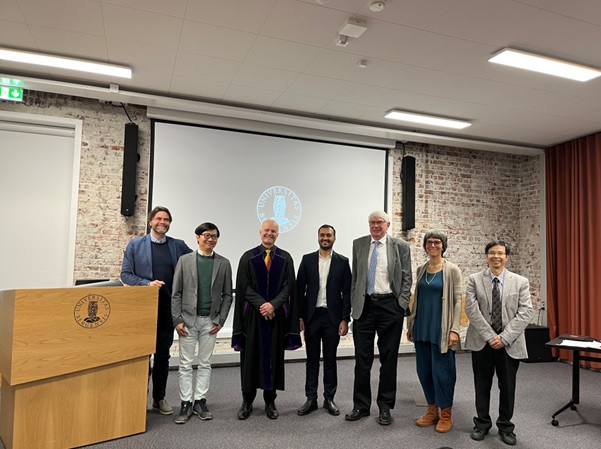
On September 29th, Peter Andrews defended his doctoral dissertation Human-AI Interaction for Video Content: Designing and Engineering Multimodal Conversational Agents.
The last years, Andrews studied how artificial intelligence can make videos more interactive and thus create a better user engagement and understanding. One paper he has worked on tested the ability of using AI to “co-moderate” political debates on video; he also developed prototypes for interactive video in sports and politics. Building on this, his PhD research developed an interactive video framework powered by AI, integrating computer vision and natural language processing to enable real-time engagement and a deeper understanding of content. His work provides valuable insights for researchers, developers, and broadcasters looking to engage the next generation of news consumers through interactive video.
The committee, composed of Professors Miroslav Bachinski (UiB), Bjørnar Tessem (UiB), Huamin Qu (Hong Kong University of Science and Technology) and Doctor Petra Isenberg (Université Paris-Saclay), offered expert feedback and assessed the scientific contribution of the work.
Nudging Healthier Choices: Ayoub El Majjodi’s Research on AI and Food Habits
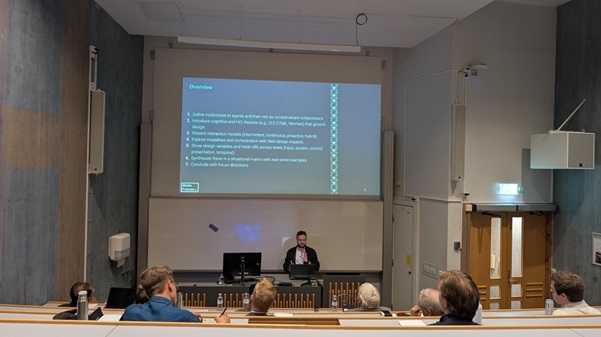
On October 23rd, Ayoub El Majjodi defended his thesis titled Recommender Systems and Nudges for Healthier Food Choices. His research bridges AI, behavioural science, and public health – exploring how recommender systems can be designed to guide people toward better and more healthy eating habits.
Using a design science research methodology, El Majjodi’s work designs and evaluates food recommendation systems augmented with nudging techniques through algorithmic tests and user experiments. The studies reveal that nudges can influence dietary decisions, but their success depends on personalization, system design, and user characteristics such as food knowledge and goals. This research advances recommender systems and persuasive technologies by demonstrating the potential of adaptive nudging and user-centric evaluation to foster informed decision-making and long-term behavioural change.
“My PhD journey has been about more than algorithms and models. It has been about understanding people, how we make choices, how technology can guide us, and how recommender systems can serve as powerful tools for positive behaviour change. My work focused on how AI can nudge users toward healthier and more sustainable eating habits, merging data science with behavioural insights to make technology truly meaningful”, says El Majjodi about his work.
The committee, consisting of Professors Erik Knudsen (UiB), Samia Touileb (UiB), Alan Said (University of Gothenburg) and Julia Neidhardt (TU Vienna), provided expert evaluation of the dissertation and assessed its scientific contribution.
From Metrics to Meaning: Marianne Borchgrevink-Brækhus’ PhD on News Practices
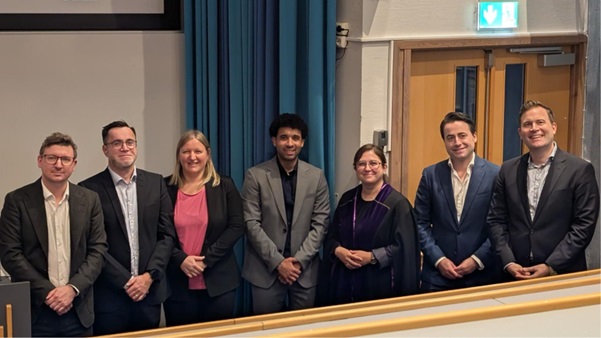
On December 9th, Marianne Borchgrevink-Brækhus successfully defended her PhD thesis News experience: Understanding why and how audiences interact with news beyond audience metrics. In her thesis she challenges journalism’s reliance on digital metrics by demonstrating through interviews and ethnographic methods that news use is shaped by lived experiences, context, and personal identities rather than just content preferences or time spent.
Bridging qualitative methods with innovative digital ethnographic approaches across different media formats and platforms, Borchgrevink-Brækhus identifies experiences with news that both shape people’s practices and behaviours. By talking with audiences instead of about them, her work challenges assumptions in journalism studies and calls for more nuanced, audience-centred approaches to understanding news practices.
The committee members, Professors Leif Ove Larsen (UiB), Dag Elgesem (UiB), Jannie Møller Hartley (Roskilde University) and Marcel Broersma (University of Groningen), offered expert feedback, evaluated the scientific contribution of the research, and guided a successful defence.
Beyond Popularity: Anastasiia Klimashevskaia’s PhD on Bias in Recommender Systems
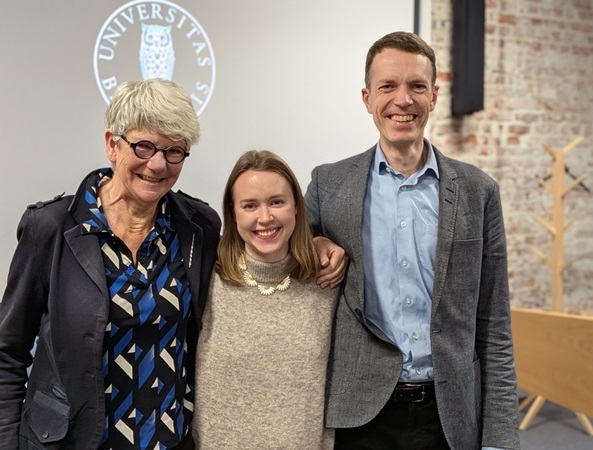
Anastasiia Klimashevskaia defended her thesis Beyond Popularity: Investigating and Mitigating Bias in Recommender Systems with success on December 15th. Her PhD thesis investigates how recommender systems over-promote popular content at the expense of niche items, explores debiasing techniques through both offline experiments and live A/B testing, and reveals the trade-offs between fairness, diversity, and recommendation quality in developing more equitable systems.
To deepen this analysis, Klimashevskaia identified the causes and consequences of popularity bias and tested mitigation strategies using real-world datasets. Her research also examines how popularity bias interacts with other algorithmic biases and introduces innovative approaches grounded in alternative theoretical frameworks. The findings pave the way for recommender systems that balance personalisation with fairness and diversity, contributing to more transparent and equitable digital platforms.
The committee, including Professors Duc Tien Dang Nguyen (UiB), Bjørnar Tessem (UiB), Marko Tkalčič (University of Primorska) and Maria Soledad Pera (Delft University of Technology), provided a comprehensive review of the dissertation, and confirmed that the candidate met the high standards required for the doctoral degree.
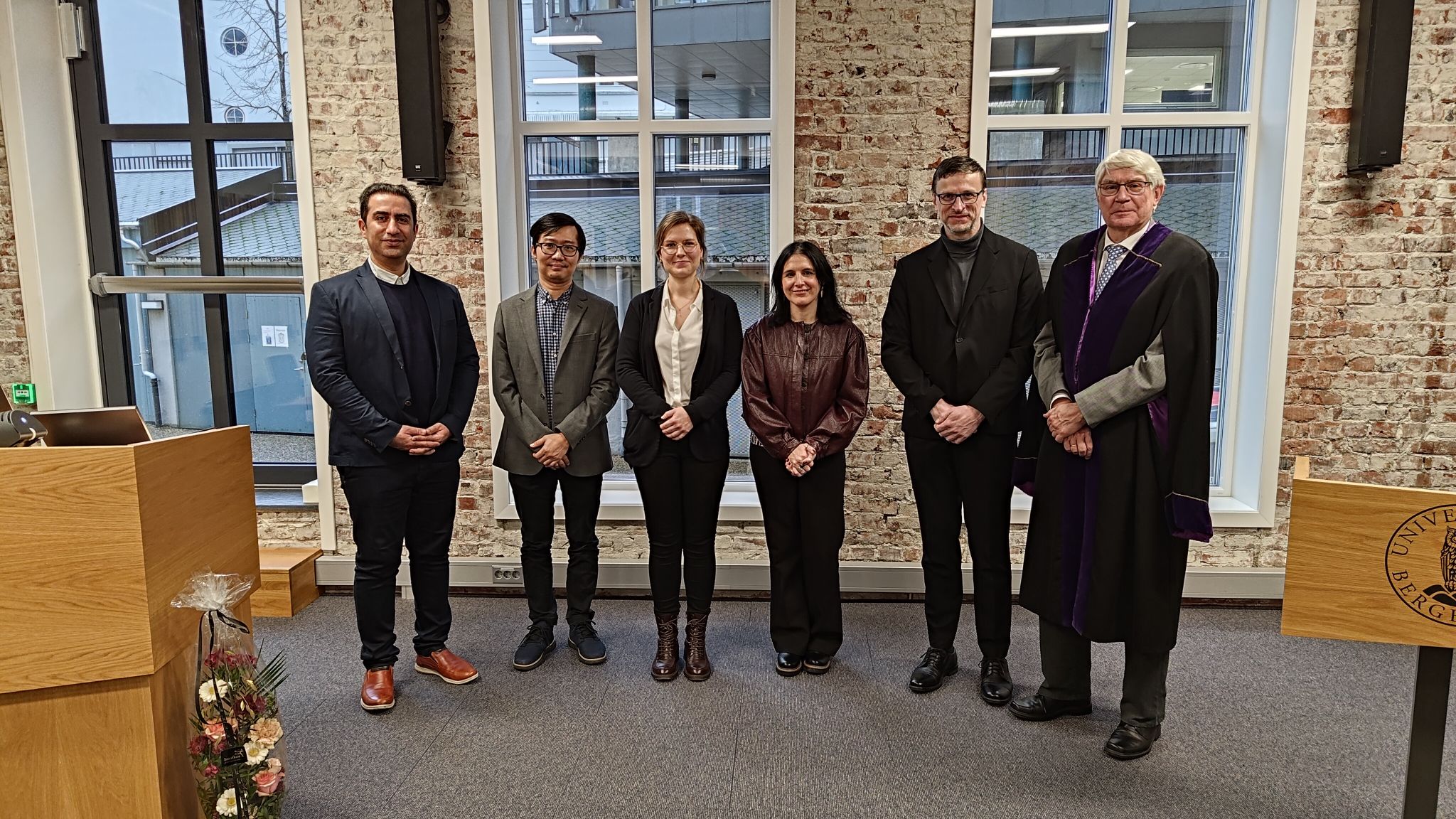
We congratulate our new PhDs and look forward to seeing their ideas make a lasting impact beyond academia!