
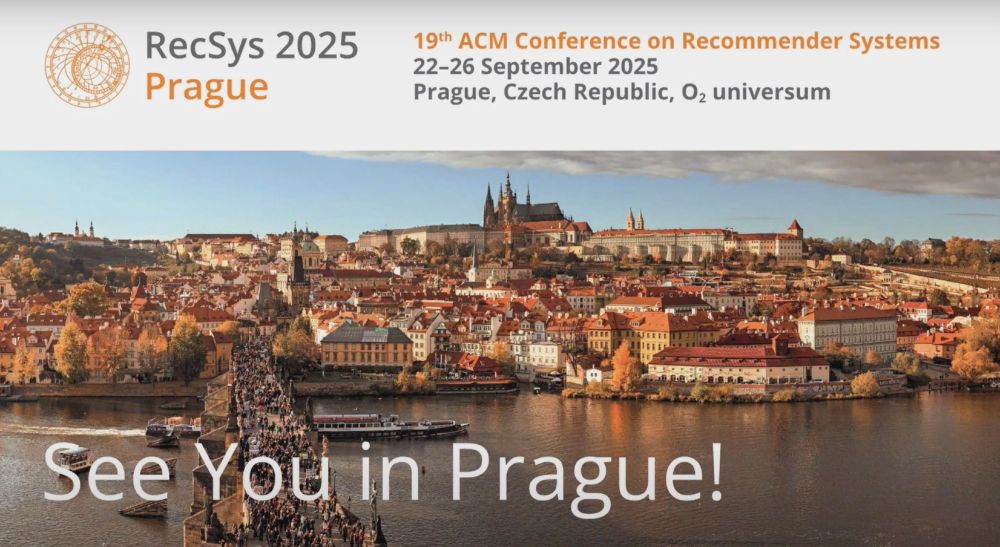
We are proud to share that six of our research papers have been accepted for presentation at different workshops co-located with ACM RecSys 2025 in Prague.
Our accepted contributions cover a diverse range of topics at the intersection of news recommender systems, AI, and responsible media technology:
- Hope, Fear, or Anger? How Emotional Framing in a News Recommender System Guides User Preferences. INRA. – Exploring how emotional reframing of news articles can influence reader engagement and openness to diverse viewpoints.
- More of the Same? A Longitudinal Evaluation of Two Similarity-based Approaches in a News Recommender System. INRA. – A long-term study comparing how different similarity thresholds affect user engagement and content diversity.
- Using Large Language Models to ‘Lighten the Mood’: Satirically Reframing News Recommendations to Reduce News Avoidance. INRA. – Investigating how AI-generated satire can help address news avoidance and re-engage readers.
- Evaluating Image Trust Labels in a News Recommender System. INRA. – Assessing the impact of visual trust indicators for images on user trust and interpretation.
- Nudging Healthy Choices: Leveraging LLM-Generated Hashtags and Explanations in Personalized Food Recommendations. IntRS’25. – Exploring how AI-generated explanations and hashtags can help users make healthier food choices, and compare their effectiveness with traditional nudges, such as nutritional food labels.
- LLM-based Healthiness? Analyzing the Nutritional Quality of an AI-Generated Recipe Dataset. RecSoGood. – Presenting a healthiness evaluation of ChatGPT-generated recipes against international nutritional metrics, revealing fascinating insights into the “dietary footprint” of AI.
These works are the result of great collaborative efforts, with the main authors being our talented Master’s students and Research Assistants at SFI MediaFutures, together with co-authors Jørgen Eknes-Riple, Jia-Hua Jeng, Alain Starke, Jonas Bech Holtan, Cataldo Musto, Alessandro Petruzzelli, Ayoub El Majjodi, Khadiga Seddik, Gloria Kasangu, Tobias Jovall Wessel, Svenja Lys Forstner, and Yelyzaveta Lysova, supervised by Center Director Professor Christoph Trattner.